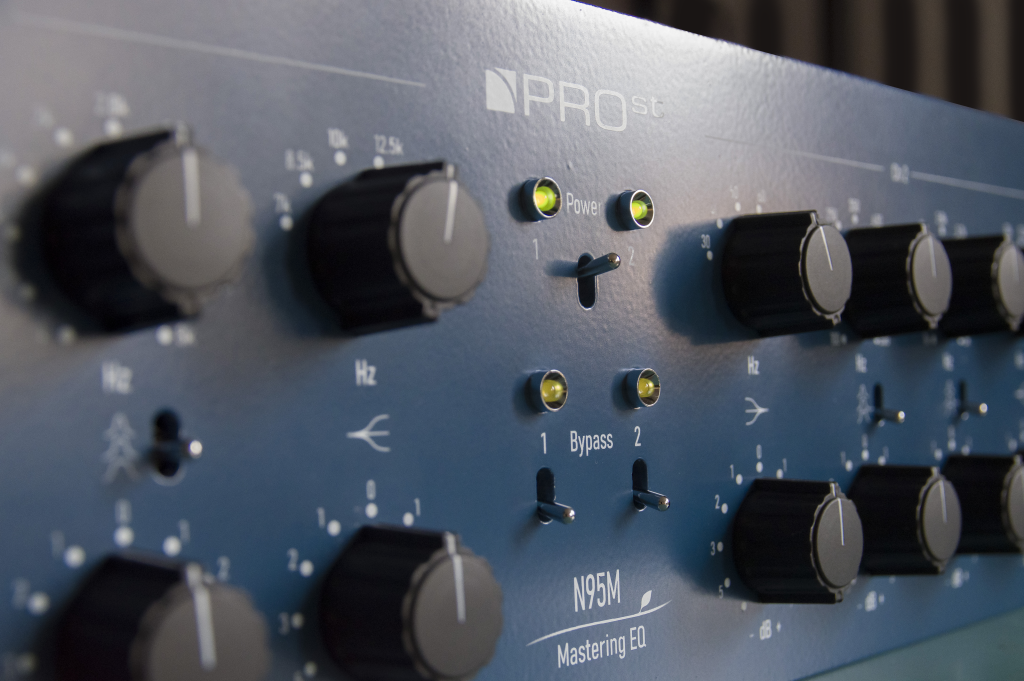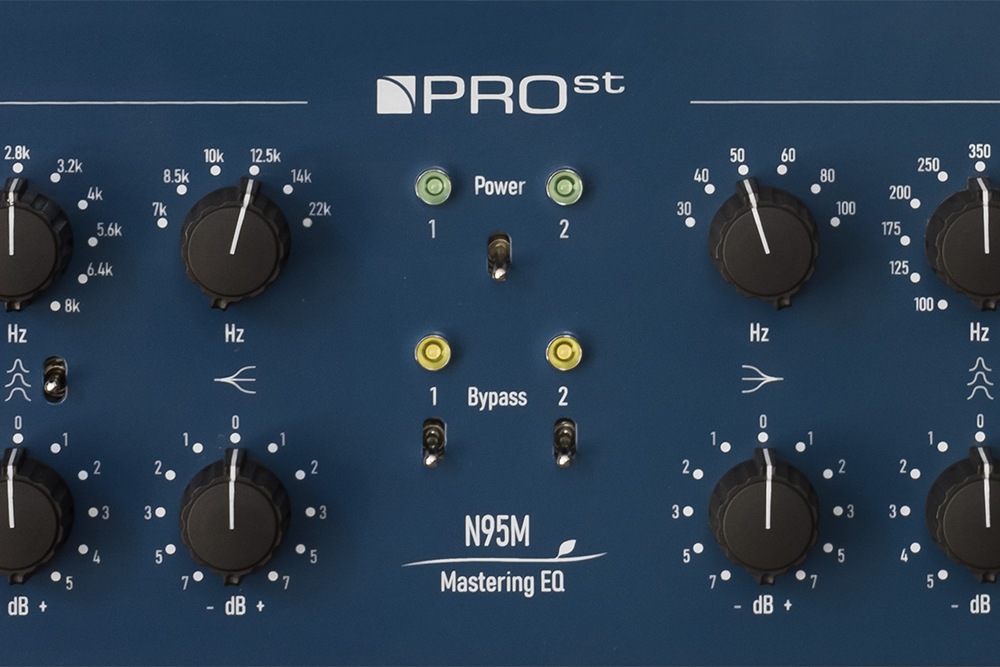
The legendary equalizers of the vinyl and cassette eras, such as the PEa & W series, earned their place in history for a reason. They shaped the sound of entire decades. However, engineering must not stand still. What was a gold standard yesterday can often become a bottleneck today.
The Context of an Era. We must acknowledge that the engineers of the 1970s worked within the strict limitations of their time. The primary distribution formats—vinyl and compact cassettes—dictated specific technical compromises. A low-frequency roll-off below 40 Hz was standard, and noise floor expectations were shaped by the physical hiss of magnetic tape. Today’s digital and high-end analog workflows demand a level of transparency and frequency extension that these vintage units were never designed to provide.
Materials and Headroom. The last 40 years have seen a leap in material science. The N95 replaces the compact toroids of the past with modern transformers from Lundahl. This is not just a matter of “flavor”; it is an objective upgrade in technical performance. These components offer significantly higher headroom in the low-frequency range and lower distortion. Combined with modern op-amps that match the original signature but offer far superior noise specs, the N95 reaches a level of detail previously unattainable.
The Architecture of Isolation. One of the most critical evolutions in the N95 is its power and ground architecture. The original vintage units were designed in the Danner-cassette format. This modular standard imposed severe spatial constraints and limited connector pinouts, which necessitated a common ground for both channels. While this was a practical engineering solution for the time, it inherently introduced crosstalk and compromised stereo separation.
The N95 moves beyond these physical limitations. It is built on an architecture of full galvanic isolation. By moving the power supplies to external enclosures and utilizing independent dual-mono signal paths, we have completely eliminated shared ground paths. This ensures absolute stereo integrity and rock-solid imaging.
Refining the Signal Path. Every legend has its weak points. During my research, I identified a fundamental defect in the original output transformer driver — a bottleneck that introduced a “dirty” coloration. Even today, the correlation between gain stage topology, trivial distortion metrics, and actual sonic performance remains widely misunderstood. In the N95, this circuit has been entirely redesigned. We have liberated the sound from artifacts that were once considered inevitable.
Furthermore, modern mastering requires greater flexibility. Moving from a 3-band to a 4-band system was made possible by a specialized 4-layer PCB layout, allowing us to maintain the shortest possible signal path while keeping the noise floor at an absolute minimum.
Conclusion. The N95 is not an exercise in nostalgia. It is the realization of the potential inherent in the original DNA, brought to life with technologies that didn’t exist in the 1970s. It provides the density and “weight” of a high-end analog path with the surgical precision required for the most demanding modern mix and mastering chains.