Nearly thirty years ago, I built my first tube amplifier. It was a turning point for me. Eventually, I decided to improve it by crafting a new, supposedly superior output transformer. On paper, it outperformed the original in every way. Imagine my surprise when I heard the result: a dead, congested sound.
That was my first experience with toroidal transformers in the signal path. I quickly diagnosed the issue and never repeated that mistake again. This story resurfaced recently during transformer shootouts for the N95 EQ, where I compared the original Hauffe transformers to several others.
Undoubtedly, all these transformers show excellent parameters during instrumental testing. However, as John William Strutt (Lord Rayleigh) said, all questions regarding sound must be settled by the ear. Based on audio expertise, my definitive choice was Lundahl.
I dislike “audiophile prose,” so I will be brief: Lundahl provides more life, naturalness, and air without any trade-offs. That is enough for me to draw a conclusion.
What is the cause of these different yet similar situations? We live in a material world; there is no mysticism here. The most critical factor is the core design. The absence of an air gap in toroidal transformers leads to significantly worse magnetic linearity.
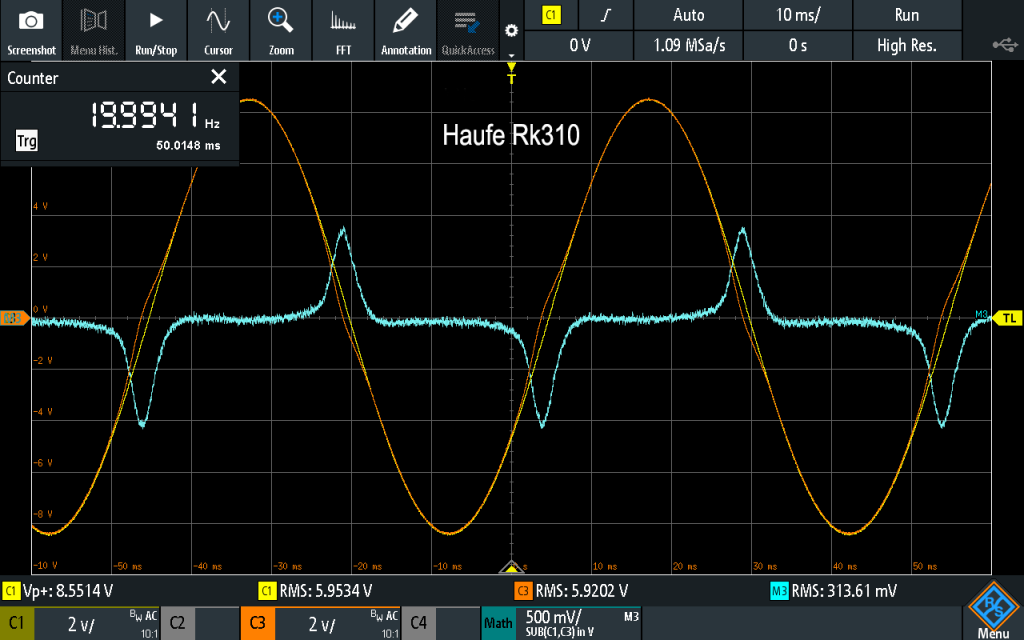
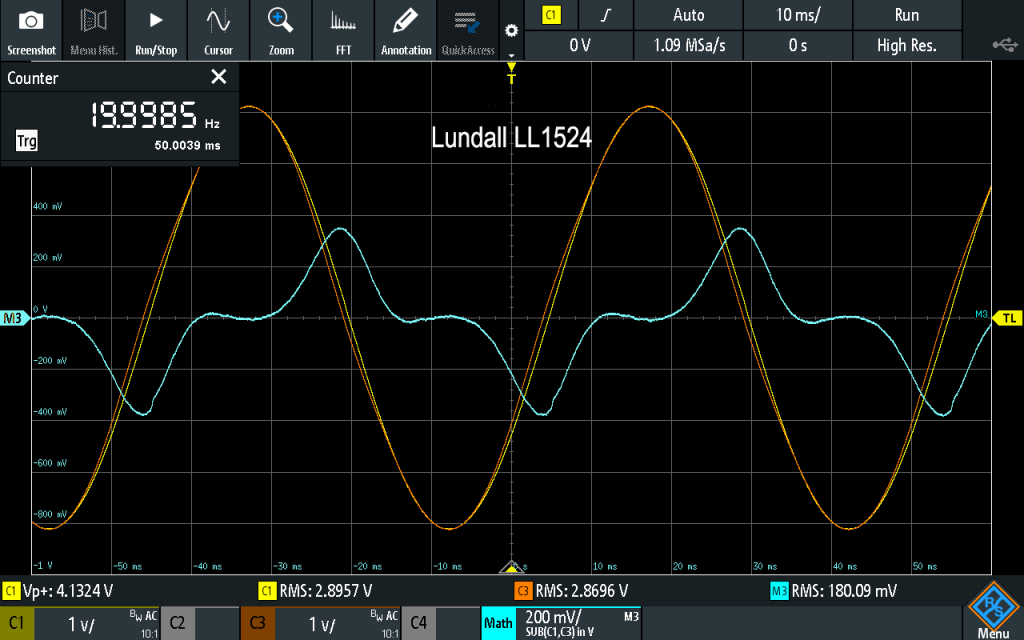
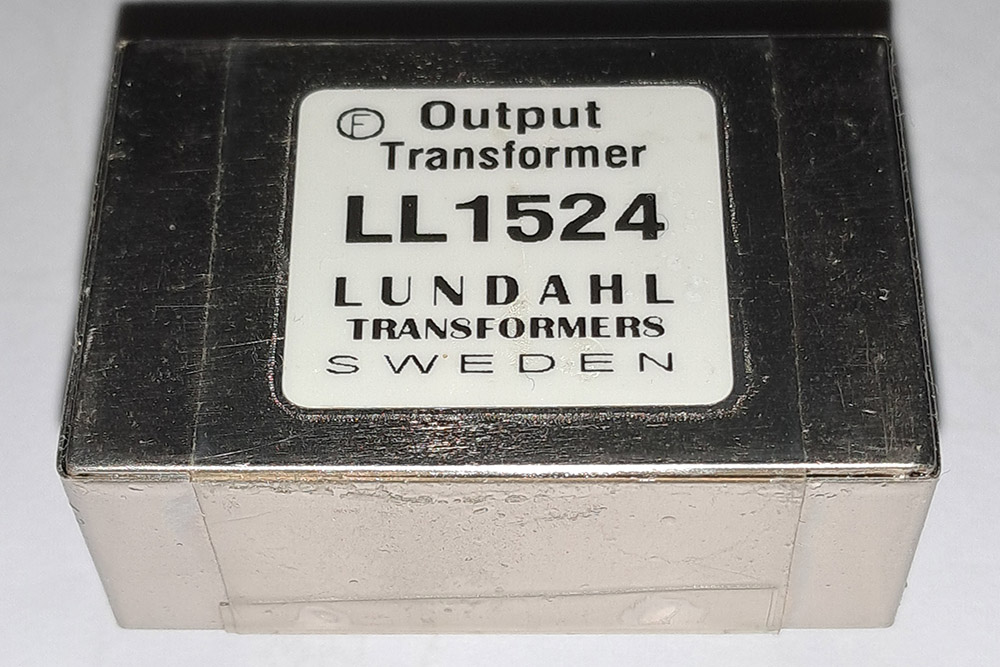
The key difference between Hauffe and Lundahl here is the magnetic circuit. The original Hauffe RK310 is a compact toroid. The Lundahls I use are C-core or laminated plates with a technological gap.
I will eventually publish a study on hysteresis loops here. For now, here are two quick screenshots (Haufe Rk310 and Lundall LL1524) showing low-frequency saturation. The blue trace represents the distortion introduced by the transformer. While this is an extreme scenario, it clearly illustrates the core’s properties: the Hauffe has a less linear characteristic with a harsher harmonic profile.